Sexually transmitted diseases are incredibly common among adults worldwide yet often misunderstood. Many adults underestimate the rates of STDs in the population, according to a US News and World Report article. The ugly truth is that over half the US population will develop a sexually transmitted infection over the course of their lifetime. Ignoring the situation will only make it worse, but that has unfortunately been status quo recently. While the general public seems to know the importance of prevention strategies like abstinence, monogamy, and condoms and of regular testing, both unawareness of the prevalence of STDs and increasing inaccessibility of STD support services have led to decreasing compliance to these recommendations.
Recent patterns
A 2019 CDC report found increasing rates of syphilis and congenital syphilis particularly alarming. The number of syphilis cases in the US surpassed 115,000 in 2018, and infant mortality rates due to congenital syphilis increased by 22% from 2017 to 2018. In the US, 5 states have seen dangerously increasing rates of syphilis and congenital syphilis, and account for 70% of congenital syphilis cases. These are Texas, California, Florida, Arizona, and Louisiana.
In response to the CDC’s report on increasing rates of syphilis, county health officials in Richmond, Indiana, went door to door offering free STD tests. They found 5 cases in only a week and a half, whereas they typically report only 2-3 per year. It’s an unfortunate demonstration of both this increasing trend and a lack of awareness and testing among adults in the US.
Outbreaks have also been recorded in Ontario and Nova Scotia, Canada, in recent months, so this is a global issue occurring in peer countries as well. WHO estimates that there are 6 million new syphilis infections each year among people 15-49 years old. In addition, congenital syphilis is responsible for over 300,000 fetal and neonatal deaths each year.
Why are we seeing increasing rates of STDs?
The CDC found 3 major factors driving increases in STDs. The first of these factors is reduced access to STD prevention and care caused by drug use, poverty, unstable housing, and stigma. The next is decreased condom use, especially among young people, gay men, and bisexual men. Finally, cuts to state and local STD programs, which have forced clinics to shut their doors, limited screening, led to staff lay offs, and decreased ability to follow-up with patients and link them to care services.
Basically, when appropriate services are difficult to find and afford, STD rates rise. Rising STD rates have a high human cost. Any chance you have to fight cuts to STD prevention and treatment programs is important, because these diseases affect people you know and can increase HIV infection rates as well.
What are syphilis and congenital syphilis?
The CDC describes syphilis as a disease caused by the Treponema pallidum bacteria spread by direct contact with a sore in or on the penis, vagina, anus, rectum, lips, or mouth. Congenital syphilis occurs when a pregnant mother transmits the disease to her baby in utero. Signs and symptoms of syphilis can be divided into stages:
- Primary- firm, round, painless sores which heal with or without treatment
- Secondary- rash (typically on the palms of your hand and soles of your feet), swollen lymph nodes, fever
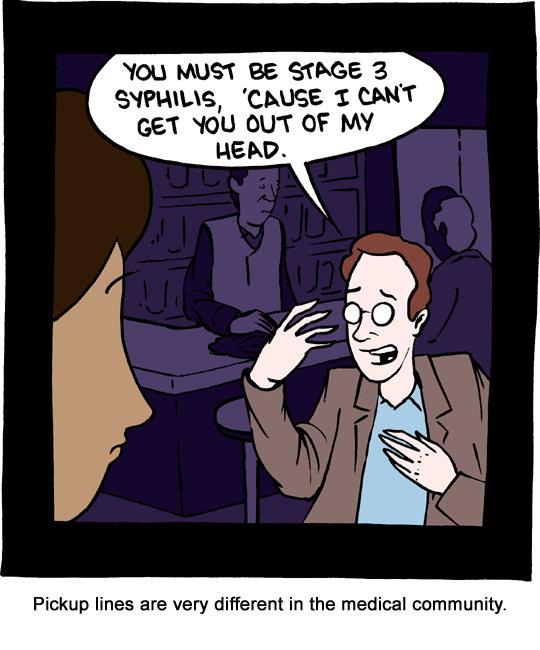
- Tertiary- severe complications affecting the heart, brain, or other organs
- Syphilis can also be latent, with no obvious signs or symptoms.
Congenital syphilis increases the likelihood of having a low birth weight, preterm, or stillborn infant. Infected infants must be treated to avoid cataracts, deafness, seizures, and death.
Syphilis prevention and treatment
Both syphilis and congenital syphilis can be cured with appropriate antibiotics, but infections may still cause permanent damage, especially if left untreated for long periods of time. Congenital syphilis can be easily prevented with the testing of pregnant mothers during pregnancy and before delivery. Use of barriers like condoms drastically reduces infection rates, but infection may still occur since sores may be located outside of barrier protections. This is why regular STD testing is important for any sexually active person and partners at the start of monogamous relationships. They can help prevent a lot of pain and keep you healthy. If you are pregnant and your doctor does not offer an STD test, consider going to a different doctor but also ask to have testing performed just in case. It is quick, painless, and easy and it can only help you and your baby to know for certain.
Additionally, there have been reports of growing antibiotic resistance for syphilis, but it is not as severe as gonorrhoea. Of larger concern is waning supplies of benzathine penicillin, an injectible antibiotic that is the WHO recommended treatment for syphilis. Funding for antibiotics is therefore also important in the fight against syphilis.
Because STDs are only cute in plush form, check out this cute reminder to get tested regularly:


 Hannah Biowell Blog